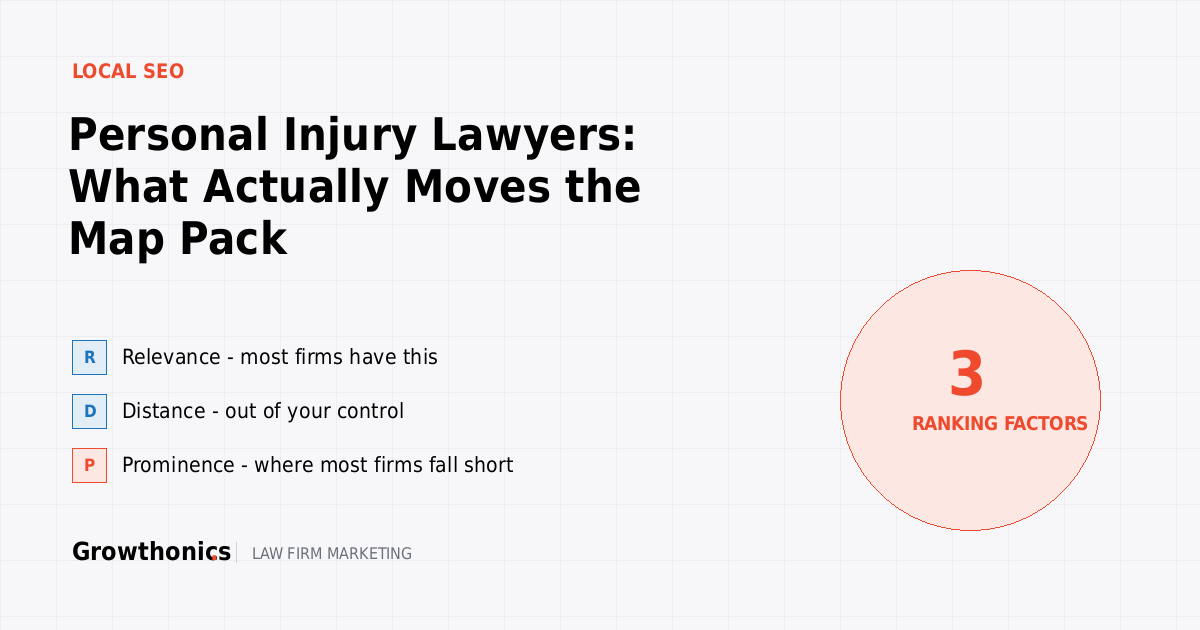
Ranking in local search as a personal injury lawyer comes down to three factors Google actually measures: relevance, distance, and prominence. Most firms handle relevance well — their website clearly says “personal injury lawyer” and lists the practice areas. Distance isn’t something you can control directly. Prominence, meaning how established and reputable your firm looks across the web, is where most firms fall short, and it’s usually the difference between a firm that ranks and one that doesn’t, even in the same city with a similar website. This is the part of law firm marketing that takes longest to build and matters most.
Here’s what that means in practice, and the specific changes that move a firm from page four to the local pack.
What Google Actually Looks At
When someone searches for legal help nearby, Google weighs three main factors to decide which firm shows up first:
- Relevance: how closely your firm matches the search intent. Someone searching “personal injury lawyer” won’t see results for an estate planning firm, even a nearby one.
- Distance: Google favors businesses closer to the searcher. A firm further away can get outranked even with a stronger online presence.
- Prominence: how established and reputable your firm looks online, based on client reviews, directory listings, and overall visibility.
It’s common for a firm’s own Search Console data to show real, meaningful search volume for exactly the terms it wants to rank for, sitting on page four or five of results. That’s not a relevance problem — Google understands what the page is about. It’s a prominence problem, and it’s fixed differently than a content problem is.
Where You Actually Show Up
Occupying more of the results page for a given search means more chances to get clicked. There are three places worth fighting for:
- Google’s Local Pack: the top three map listings, showing location, directions, hours, and reviews.
- Local Services Ads: screened Google Ads that appear above organic results.
- Organic search results: your website ranking near the top of local listings.
For solo practitioners and small firms, ranking well locally can matter more than firm size. It’s not about outspending national firms; it’s about showing up at the moment a nearby client actually needs you.
Five Things That Actually Move the Needle
1. Optimize your Google Business Profile completely, not partially
Your Google Business Profile drives visibility in the Local Pack, Maps, and local search results.
- Claim and verify your profile by mail or phone.
- Keep your name, address, and phone number (NAP) consistent everywhere it appears online.
- Choose the most relevant primary and secondary categories.
- Write a concise, keyword-aware business description.
- Upload real photos of your team, office, and logo, not stock images.
- Publish Google Posts regularly to share updates or results.
A profile that’s claimed but not maintained is a missed opportunity, not a finished task.
2. Build one page per location you actually serve
A single page listing every office location doesn’t work for local SEO. To rank in multiple cities, build a dedicated page for each area you serve. Someone searching “personal injury lawyer in [city]” is more likely to find a firm with a page built specifically for that search than one relying on a single generic locations page.
Each location page should include a localized title with the target city, content that references regional courts and case results specific to that area (where you can back the claim with a real result), an embedded Google Map showing the exact office, and consistent NAP information in the header and footer.
3. Write meta titles and descriptions that earn the click
An effective local meta title includes your legal service, your location, and your firm’s name, while staying within Google’s display limits so it doesn’t get cut off in search listings.
4. Treat reviews as a ranking input, not just marketing
Review count, recency, and rating feed directly into the prominence factor above. A firm that asks every closed case for a review, consistently, tends to outrank a firm with the same website but a thin or stale review profile.
5. Get named on other credible sites, not just your own
Directory listings, bar association profiles, and legitimate local press mentions all contribute to prominence. This is also the piece most firms skip, because it’s slower and less visible than fixing a website page, and it’s usually the actual gap between a firm that ranks and one that doesn’t.
Frequently Asked Questions
How long does local SEO take to show results for a personal injury lawyer?
Meaningful movement typically takes 3 to 6 months, since prominence signals like reviews and third-party citations build gradually rather than changing overnight. Google Business Profile optimization tends to show the fastest partial results, often within a few weeks.
Do I need a separate page for every city I serve?
Yes, if you actually serve clients there and can write real, location-specific content for it. A thin page with just a city name swapped in performs worse than not having the page at all.
Does my Google Business Profile matter more than my website for local rankings?
They work together, but the Google Business Profile is usually the faster lever. It directly controls Local Pack visibility, while your website’s authority and prominence signals take longer to build.
What’s the difference between local SEO and Local Services Ads?
Local SEO builds organic visibility you don’t pay per click for. Local Services Ads are a paid, Google-screened ad format that appears above organic results. They can work well together, but they’re separate systems with separate requirements.