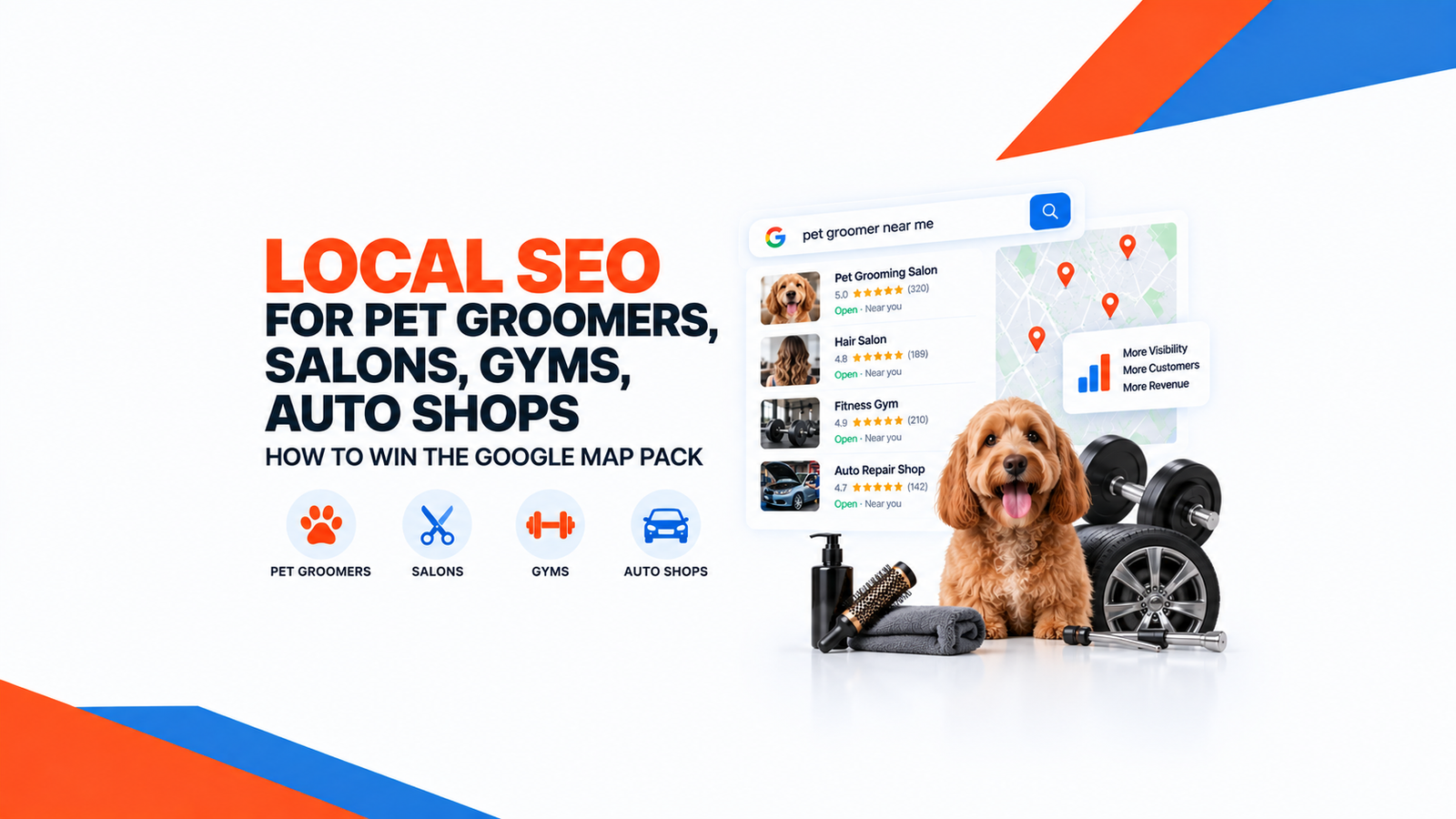
Local SEO for local service businesses like these starts with one simple fact: a pet groomer, a hair salon, a gym, and an auto repair shop don’t have much in common on the surface. But ask how their best new customers actually find them, and the answer is almost always the same. They searched on their phone, saw a handful of businesses on the map with pins and star ratings, and picked one before ever visiting a website.
That’s the Google Map Pack — the block of three local business listings that shows up above the regular search results for almost any "near me" search. For these four kinds of businesses, winning a spot in it matters more than almost anything else you could do in marketing.
Why the Map Pack matters more than your rank on page one
Someone searching "dog groomer near me," "hair salon open now," "gym near me," or "auto repair shop near me" is almost always ready to book, call, or drive over today. Google knows this, so it prioritizes the three-listing Map Pack above traditional blue-link results for these searches, driven by proximity, relevance, and prominence (mainly reviews). If you’re not in that pack, most of that traffic never reaches your website at all.
Local SEO for local service businesses: the Google Business Profile checklist
Before anything else, your free Google Business Profile (GBP) needs to be complete and accurate. Run through this list:
- Primary category is exact — "Dog Groomer," not "Pet Store"; "Hair Salon," not "Beauty Salon," if that’s not quite right.
- Every service is listed — nail trims, mobile grooming, personal training, oil changes, whatever applies.
- Hours are current, including holiday hours — a wrong "closed" listing on a Sunday costs real walk-ins.
- Photos are recent and real — actual storefront, staff, and work, not stock photos.
- You’re responding to every review, good and bad, within a few days.
- Review volume and recency are healthy — a 4.8 rating from 2019 loses to a 4.3 rating with reviews from last week.
- Q&A section is seeded with the questions customers actually ask (do you take walk-ins, do you work on [make/model], etc.).
- Website and booking links work and go to a mobile-friendly page.
- NAP consistency — your name, address, and phone number match exactly across your website, GBP, and any directory listings (Yelp, Nextdoor, etc.).
- Posts are active — a monthly GBP post (a promotion, a new service, a seasonal reminder) signals an active, trustworthy business.
Growthonics built a free Google Business Profile Health Check tool that scores your profile against exactly these factors in under a minute.
Pet groomers & pet service businesses
Pet owners search with urgency ("emergency nail trim near me") and with loyalty once they find someone they trust. Beyond the GBP basics, the highest-leverage move is making it dead simple to book online and showing real before/after photos. Pet owners are visual searchers, and a groomer’s Google photos are often the deciding factor between two similarly-rated options nearby.
Salons & spas
Salon searches are split between loyalty ("my stylist") and discovery (someone new to the area, or unhappy with their last cut). Discovery searches are where local SEO wins new clients. Service-specific pages, like balayage, keratin treatment, or men’s cuts, rank for more specific, lower-competition searches than a single generic "hair salon" page ever will, and they match exactly what someone is searching for.
Fitness studios & gyms
Gym searches spike hard in January and again in late summer, but the businesses that win aren’t just riding the spike. They’re visible year-round with content that answers real hesitations, like "how much does a gym membership cost," "best gym for beginners," or "drop-in class rates." A free trial class or day pass, prominently offered on the GBP profile and website, converts far better than a generic "join now" button.
Auto repair & dealerships
Auto repair searches are often urgent and trust-driven — nobody wants to guess at a mechanic. Reviews matter enormously here, and so does transparency. Shops that publish typical price ranges for common services, like oil changes, brake pads, or check-engine diagnostics, reduce the biggest objection in the category: fear of being overcharged.
Frequently asked questions
How many Google reviews do I need to rank in the map pack?
There’s no fixed number, but review quantity, recency, and rating all factor into Google’s local ranking algorithm. In competitive areas, businesses with 50+ recent, mostly positive reviews tend to outperform those with only a handful. That’s true even if the older listing has technically been around longer.
Does responding to reviews affect local ranking?
Yes, indirectly. Google has said owner responses are a signal of an active, engaged business. Responding, especially to negative reviews, also improves conversion once a searcher lands on your profile, since it shows real accountability.
How often should a local business post to Google Business Profile?
Once every week or two is a reasonable target for most small local businesses. GBP posts expire after seven days for most post types, so a completely dormant profile can look less active than a competitor’s, even if both businesses are equally busy.
Is it worth having a website if most customers find me through Google Maps?
Yes. Your Google Business Profile is often the first touchpoint. But a fast, mobile-friendly website with service pages, pricing information, and online booking is what turns a Map Pack click into an actual appointment. It also gives Google more content to understand and rank your business for.
Should I use the same categories and descriptions across Yelp, Google, and Nextdoor?
Your business name, address, and phone number (NAP) should match exactly everywhere. Category names and descriptions can vary slightly by platform since each has its own taxonomy, but they should describe the same core services consistently.
Want a free, no-signup check of exactly where your profile stands? Try the Google Business Profile Health Check or the full free digital marketing audit.
See how Growthonics helps each of these businesses grow: pet services marketing, salon & spa marketing, fitness studio & gym marketing, and auto repair & dealership marketing.