Want to stand out to prospective clients searching for a good lawyer in your area? Local SEO is how you get there, generating leads without paying for clicks. We help law firms expand their visibility exactly where clients are looking: in the local pack and on Google Maps.
Building trust through client reviews and accurate local citations, and prioritizing the right audience in your area, helps law firms attract the clients they actually want. In this post, we’ll break down the local SEO strategies that have delivered results across a range of practices.
What Is Local SEO and Why Does It Matter for Lawyers?
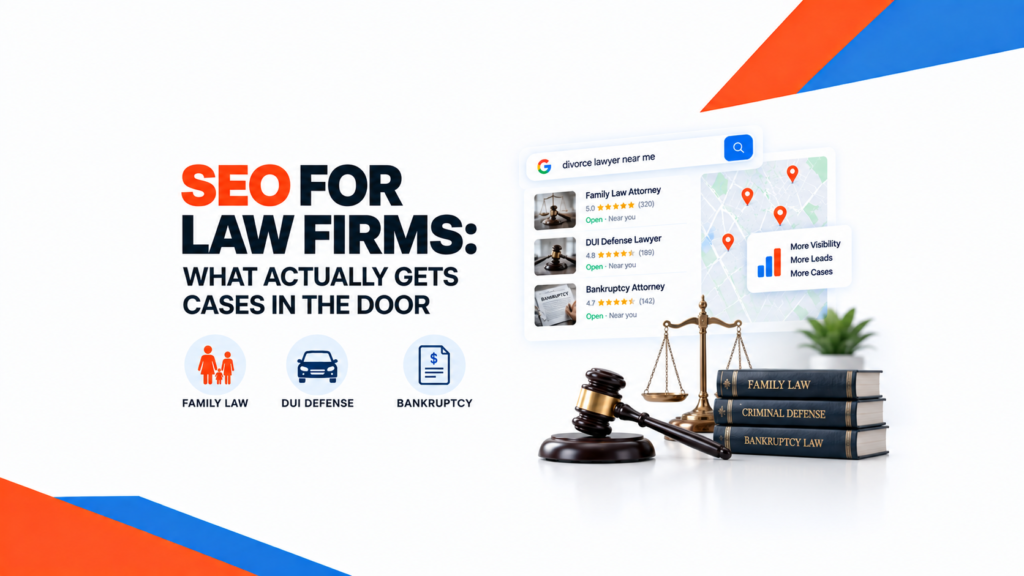
Local SEO helps law firms streamline their online presence so they show up exactly where clients seeking legal services in their area are searching. When someone nearby searches for legal help, your firm has a chance to appear in several key spots:
- Google’s Local Pack: the top three map listings, showing location, directions, hours, and reviews.
- Local Services Ads: screened Google Ads that appear above organic results.
- Organic search results: your website ranking near the top of local listings.
The more space you occupy on that results page, the more likely someone clicks through to you. Why does this matter? High-intent searchers are often ready to contact a lawyer right away, most traffic and cases come from the top local results, and local SEO builds visibility you don’t pay per lead for.
For solo practitioners and small firms, ranking well locally can matter more than firm size. It’s not about outspending national firms. It’s about showing up at the moment a nearby client actually needs you.
How Google Ranks Law Firms for Local SEO
When someone searches for legal help nearby, Google weighs three main factors to decide which firm shows up first. Understanding them is the first step to outranking nearby competitors:
- Relevance: how closely your firm matches the search intent. Someone searching “personal injury lawyer” won’t see results for an estate planning firm, even a nearby one.
- Distance: Google favors businesses closer to the searcher. A firm further away can get outranked even with a stronger online presence.
- Prominence: how established and reputable your firm looks online, based on client reviews, directory listings, and overall visibility.
Five Strategies That Actually Work
With those ranking factors in mind, here are five proven, real-world tactics successful law firms use to build strong local visibility.
1. Optimize Your Google Business Profile
Your Google Business Profile drives your visibility in the Local Pack, Maps, and local search results.
- Claim and verify your profile by mail or phone.
- Keep your name, address, and phone number (NAP) consistent everywhere.
- Choose the most relevant primary and secondary categories.
- Write a concise, keyword-aware business description (up to 750 characters).
- Upload high-quality photos of your team, office, and logo.
- Publish weekly Google Posts to share updates or results.
Staying competitive means keeping your profile current, responding to reviews, and posting updates regularly.
2. Build Location-Specific Pages
A single page listing every office location doesn’t work for local SEO. To rank in multiple cities, build a dedicated landing page for each area you serve. Someone searching “personal injury lawyer in Scottsdale,” for example, is more likely to find a firm with a page built specifically for that search.
How to Structure a Strong Local Page
Structure your URL. A solid local SEO strategy starts with a clean URL structure. Your site should follow a clear, logical hierarchy that both search engines and visitors can follow quickly. A consistent URL format across every local page sends clear location signals to search engines while giving potential clients location-specific content.
Build a consistent page layout. Once your URL structure is set, every local landing page should follow a consistent layout. A well-optimized local page should include:
- A localized title with the right keyword phrase, like “Personal Injury Lawyer in Scottsdale.”
- An image of a local landmark or your actual office.
- Content that references regional courts, laws, and case results specific to that area.
- An embedded Google Map showing your exact office location.
- Consistent NAP information in the header and footer.
Write strong meta titles and descriptions. These drive clicks from local search results. An effective local meta title includes your legal service, your location, and your firm’s name, while staying within Google’s display limits so it doesn’t get cut off in search listings.
Well-structured local pages, combined with attention to meta titles, help your firm attract high-intent local clients and improve visibility for area-specific searches.