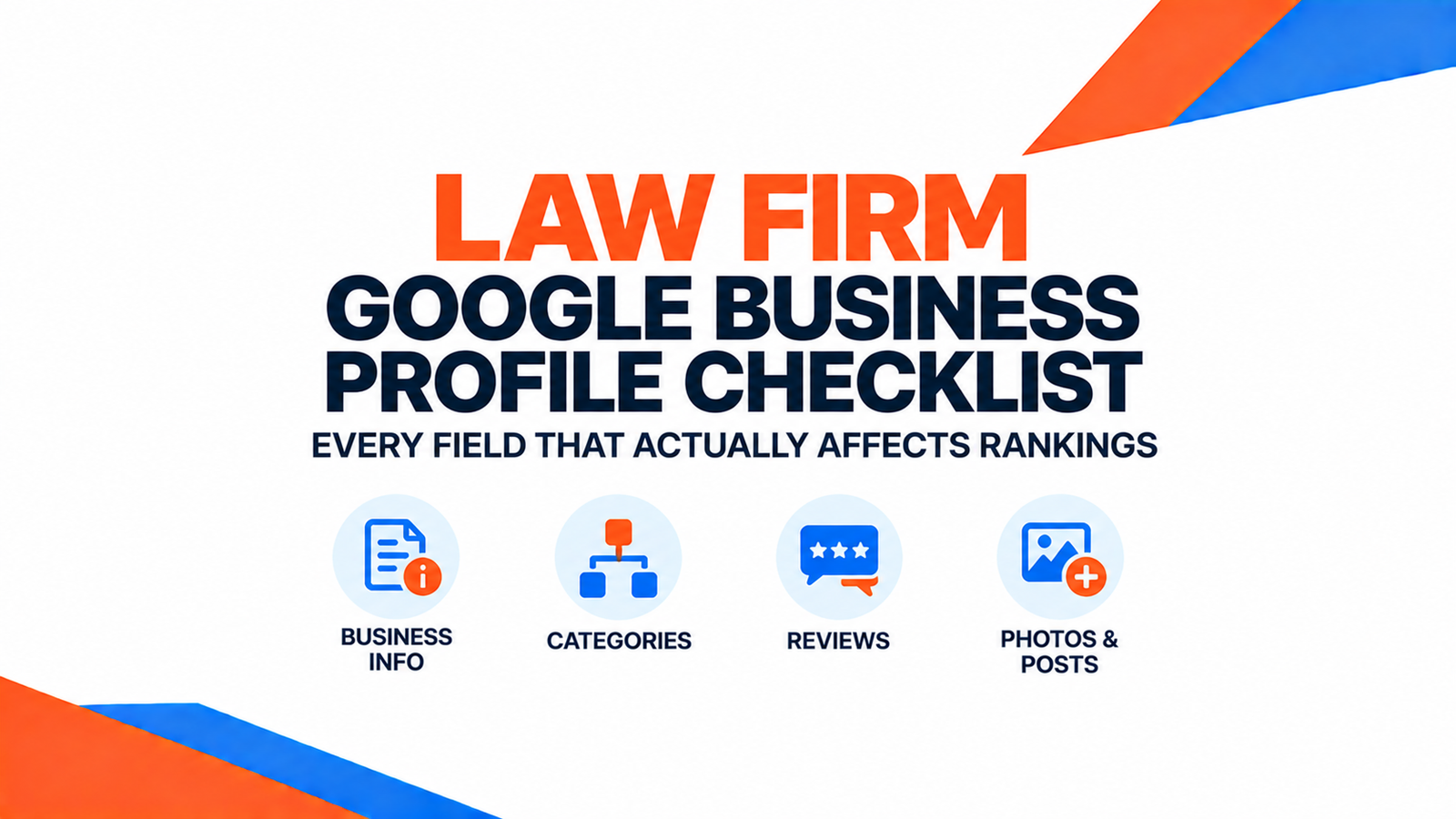
The fields on a law firm’s Google Business Profile that actually affect local rankings are the primary category, the business description, completed attributes, and an active post and photo cadence, not just the name, address, and phone number most firms stop at. A profile that’s “claimed” but only half-filled out is competing against firms that filled in every field Google offers, and prominence, one of Google’s three local ranking factors, rewards the more complete profile.
Here’s every field worth checking, and what happens when it’s missing.
Business Information
- Business name: should match your real, legal business name exactly as it appears on your signage and website. Adding keywords that aren’t part of your actual name risks a suspension.
- Primary category: choose the most specific accurate category available (for example, “Personal Injury Attorney” rather than the generic “Lawyer”) since this is one of the strongest relevance signals Google uses.
- Secondary categories: add every category that genuinely applies to services you offer, not just adjacent ones.
- Address and service area: keep this identical to what appears on your website and other directory listings. Inconsistent NAP (name, address, phone) data across the web weakens prominence.
- Phone number: use a local number tied to the listed location, not a national call-center line.
- Website URL: link to the specific practice-area or location page relevant to that profile, not just your homepage, if you’re managing multiple locations.
Hours and Attributes
- Regular hours: keep accurate and updated, especially around holidays.
- Attributes: Google offers attributes like “Wheelchair accessible,” “Online appointments,” and language options. Fill in every one that’s true.
- Business description: use the full character allowance to describe your practice areas in plain language, naturally including the terms clients actually search for.
Photos and Posts
- Photos: upload real photos of your office, team, and signage. Profiles with photos get meaningfully more requests for directions and website clicks than profiles without them.
- Google Posts: publish updates, case results you’re permitted to share, or firm news at least every few weeks. An inactive profile signals lower prominence than one with recent activity.
Reviews and Q&A
- Review count and recency: both factor into ranking. A firm with 40 reviews from the last year outranks a firm with 40 reviews all from three years ago, all else equal.
- Review responses: respond to every review, positive and negative. An unanswered review, especially a negative one, is a visible gap to anyone reading your profile.
- Questions & Answers: this section is public and editable by anyone. Seed it with the questions prospective clients actually ask, and monitor it for incorrect answers from other users.
This checklist is one piece of a broader law firm marketing strategy. It pairs directly with local SEO fundamentals: this checklist covers the profile itself, while your website’s location pages and prominence signals cover the rest.
Frequently Asked Questions
How long does it take for Google Business Profile changes to affect rankings?
Most changes show some effect within a few days to a few weeks. Attribute and category changes tend to show up faster than shifts driven by review count and recency, which build more gradually.
Can I use a virtual office address for my Google Business Profile?
No. Google requires a real, staffed location for a service-area or storefront listing, and using a virtual address that doesn’t meet Google’s guidelines risks suspension.
Does responding to reviews actually affect rankings?
It contributes to prominence indirectly, and it directly affects conversion, since prospective clients read responses to judge how a firm handles complaints and feedback.
Should I list every practice area as a separate category?
Add every category that’s genuinely accurate, but keep the primary category as the single most specific match to your main practice area. Overloading on marginally relevant categories can dilute relevance rather than strengthen it.